PPWR for Hotels: What to Prepare Before 12 August 2026
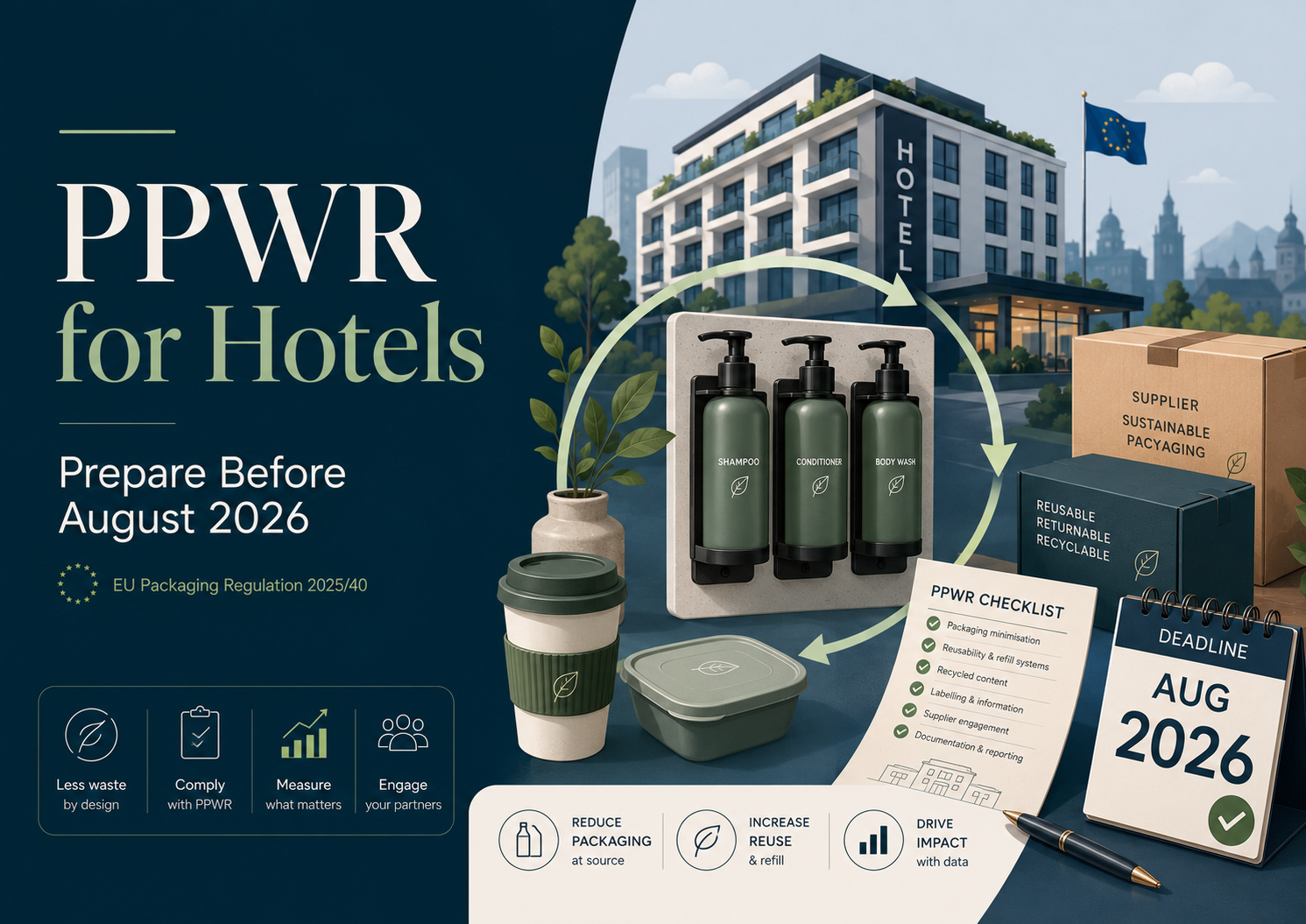
The EU’s new Packaging and Packaging Waste Regulation — Regulation (EU) 2025/40, commonly called PPWR — is easy to misread as a packaging-industry problem.
For hotels, it is much more practical than that.
It affects what procurement teams buy, what F&B teams serve, what housekeeping places in rooms, what guests see at breakfast or take-away counters, and what ESG teams can credibly report. From mini toiletries and single portions to refillable dispensers, reusable take-away containers and supplier packaging, PPWR turns packaging waste into an operational issue.
The key date is not 2030. It is 12 August 2026, when the regulation generally starts to apply. PPWR entered into force on 11 February 2025 and covers all packaging and packaging waste, regardless of material or origin. It sets requirements for packaging placed on the EU market and includes measures on prevention, waste management, reusability and recoverability. The European Commission summarizes the scope and application date on its packaging waste page.
If you are reading this close to August 2026, the useful question is not whether there is enough time for a perfect programme. There is not. The useful question is what your hotel can map, assign and start measuring before the date arrives, so later supplier, refill and reuse decisions are not made from a blank page.
For hotel operators, the question is no longer: “Will this affect us?”
It is: “Do we know where packaging enters our operation, where it becomes waste, and what evidence we have that we are improving?”
This article is not legal advice. It is an operational readiness guide for hotel teams that need to prepare before obligations become visible to guests, auditors and public authorities.
Why PPWR matters for hotels
Packaging waste is not marginal. In 2023, the EU generated 79.7 million tonnes of packaging waste, equal to 177.8 kg per inhabitant. Paper and cardboard represented 40.4% of the total, followed by plastic at 19.8%, glass at 18.8%, wood at 15.8% and metal at 4.9%. Eurostat reports these figures in its packaging waste statistics.
Hotels sit at the intersection of several packaging flows:
- Guest-room amenities
- Breakfast and buffet portions
- Bar, café and take-away packaging
- Room-service packaging
- Laundry and housekeeping supplies
- Supplier and transport packaging
- Event and catering materials
- E-commerce and maintenance deliveries
That makes PPWR especially relevant for hospitality. The regulation aims to make packaging less wasteful, more recyclable, clearly labelled, safer, and more supportive of reuse and refill systems. The European Commission states that all packaging should be recyclable by 2030 and that reuse or refill options should be available whenever possible.
For hotels, this creates three practical pressures.
First, procurement teams will need better supplier evidence. A claim that a package is “eco-friendly” will not be enough. Hotels will increasingly need to know whether packaging is recyclable, reusable, refillable, compliant with substance restrictions, and aligned with future labelling requirements.
Second, operations teams will need new processes. Refill and reuse only work if staff know where containers are accepted, cleaned, stored, returned and communicated to guests.
Third, ESG teams will need data. Packaging reduction cannot be proven with a policy statement. It needs baselines, recurring measurements and a clear link between action and outcome.
What changes from August 2026
PPWR is not a single deadline. It is a staged regulation.
The general application date is 12 August 2026. That means hotels should treat 2026 as the operational starting point, even where specific obligations phase in later. Portugal's Agência Portuguesa do Ambiente also notes that the regulation is applicable from 12 August 2026 on its packaging and packaging waste page.
From August 2026, hotel groups should be ready to answer basic questions:
- Which packaging formats are used across rooms, F&B, events, housekeeping and maintenance?
- Which suppliers place packaging on the EU market?
- Which items are single-use, reusable, refillable, recyclable or difficult to recycle?
- Which packaging is customer-facing and therefore relevant to guest communication?
- Which flows are already measured and which are still estimated?
- Which departments own the operational change?
There is an important nuance: some detailed technical requirements will depend on delegated or implementing acts. The regulation itself includes staged dates for labelling, reuse, reporting and related implementation measures.
So the right approach is not panic. It is structured preparation.
Hotels do not need to solve every packaging challenge in one quarter. But they should avoid waiting until 2027 or 2030 to build the basics: inventory, supplier review, process ownership and measurement.
The HORECA deadlines: refill, reuse and take-away
The most direct hospitality obligations concern HORECA activities, especially take-away food and beverages.
By 12 February 2027, final distributors in the HORECA sector that sell hot or cold drinks or ready-prepared food in take-away packaging must provide a system that allows consumers to bring their own containers to be filled. Article 32 of Regulation (EU) 2025/40 also requires conditions that are no worse than the equivalent single-use packaging option.
By 12 February 2028, HORECA operators must offer consumers the option to obtain take-away drinks or ready-prepared food in reusable packaging within a reuse system, subject to exemptions such as micro-enterprises. Article 33 treats this as a separate obligation from refill.
That distinction matters:
| Concept | What it means in practice |
|---|---|
| Refill | The guest or customer brings, owns or keeps the container. The operation fills it. |
| Reuse | The packaging circulates through a system: return, collection, cleaning or reconditioning, and re-use. |
| Recycling | The packaging becomes waste and is processed into material for new use. |
For hotels, refill may apply to cafés, bars, breakfast counters, grab-and-go areas, event catering or public-facing F&B operations. Reuse is more demanding because it requires a system. That system may be internal, supplier-managed, or part of a shared network.
The Council of the EU has also highlighted restrictions on certain packaging formats, including single-use plastic packaging for food and beverages, condiments and sauces in the HORECA sector, and small cosmetic and toiletry products used in accommodation, in its packaging policy summary.
This is where PPWR becomes visible to guests. A hotel can change procurement quietly. It cannot quietly change shampoo bottles, breakfast sachets, coffee cups, take-away containers or signage.
What this means inside a hotel operation
PPWR readiness should not sit only with legal or sustainability teams. It cuts across daily operations.
Guest rooms
Mini toiletries, individually packaged hygiene products and amenity packaging should be reviewed against the direction of the regulation. Hotels should map which products are single-use, which are refillable, and which rely on supplier take-back or bulk formats.
A practical first step is to calculate single-use amenity units per occupied room. For example, a 120-room hotel with 75% annual occupancy has roughly 32,850 occupied room-nights per year. If each occupied room uses two single-use amenity items, that is about 65,700 guest-room packaging units annually before accounting for partial use, replacements or housekeeping loss.
That number is not a regulatory metric by itself. But it gives the GM, procurement team and ESG lead a baseline for action.
Breakfast and F&B
Breakfast buffets often contain high-volume, low-weight packaging: butter portions, jam portions, sugar sachets, condiment packets, tea envelopes and small dairy servings. These items are easy to overlook because they are cheap, familiar and operationally convenient.
The risk is replacing one format with another without understanding the whole impact. A bulk dispenser may reduce packaging but require cleaning, monitoring, food safety controls and staff routines. The best decision is not always “remove plastic”. It is “reduce avoidable packaging without creating food waste, hygiene risk or operational friction”.
Take-away and grab-and-go
For hotel cafés, rooftop bars, lobby markets and conference catering, PPWR requires earlier planning. Teams need to decide where customer-owned containers can be accepted, what hygiene checks staff should follow, how reusable alternatives will be offered, and how prices will be communicated.
Signage matters. If the guest does not know a refill or reusable option exists, the system is not operationally real.
Procurement and suppliers
Hotels should update procurement questionnaires before contracts renew. Suppliers should be asked for clear information on packaging composition, recyclability, recycled content where relevant, reuse or take-back options, and documentation.
This is especially important for multi-property hotel groups. A property-level workaround may solve one hotel’s problem but create inconsistency across a portfolio.
Waste handling
PPWR will also affect how hotels think about waste sorting and reporting. The regulation introduces harmonisation of labelling and consumer information, intended to make it clearer how packaging should be sorted, returned or reused.
Hotels should prepare for this by checking whether internal bins, back-of-house sorting areas and guest-facing waste points are aligned. A beautifully designed guest label does little if back-of-house waste streams are mixed.
A 90-day PPWR readiness checklist for hotels
The best first step is not a legal memo. It is an operational map.
Days 1–30: Build the baseline
Create a packaging inventory across five areas:
- Guest rooms and amenities
- Breakfast and F&B
- Take-away, bar and café operations
- Housekeeping and laundry supplies
- Supplier, transport and delivery packaging
For each item, record:
- Supplier
- Material
- Format
- Single-use, refillable, reusable or recyclable status
- Estimated monthly volume
- Department owner
- Guest-facing or back-of-house use
- Available alternative
- Contract renewal date
The goal is not perfection. It is visibility.
Days 31–60: Prioritise the highest-impact flows
Rank packaging by three criteria:
- Volume: Which items generate the most units or weight?
- Visibility: Which items are seen by guests?
- Regulatory exposure: Which items are linked to HORECA, take-away, amenities or supplier compliance?
Most hotels will find quick wins in breakfast portions, room amenities, take-away cups, supplier cardboard, bottled water and housekeeping consumables.
Days 61–90: Turn readiness into operating rules
Create simple operating rules for each priority flow:
- What changes?
- Who owns it?
- What must staff do differently?
- What supplier evidence is required?
- What will be measured monthly?
- What will be communicated to guests?
This is where PPWR readiness becomes management discipline.
For example:
“From Q2, all lobby café take-away drinks must offer a customer-owned container option. Staff will accept clean containers, apply the same price as disposable cups, and record weekly disposable cup purchasing volume.”
That is specific, measurable and operational.
What hotels should measure
A hotel does not need dozens of packaging KPIs. It needs a small set that links action to outcome.
Recommended starting KPIs:
| KPI | Why it matters |
|---|---|
| Packaging waste per guest-night | Normalises waste against occupancy. |
| Single-use amenity units per occupied room | Tracks guest-room packaging reduction. |
| Disposable take-away items purchased per month | Shows whether refill/reuse options reduce procurement. |
| Refill adoption rate | Measures guest uptake where refill is offered. |
| Reusable packaging return rate | Tests whether the reuse system works. |
| Supplier packaging weight or volume | Helps procurement reduce upstream packaging. |
| Waste contamination rate | Shows whether sorting instructions are working. |
Where exact waste weights are unavailable, hotels can start with purchasing data. Procurement volumes are often the fastest proxy for packaging reduction.
The important point is consistency. A rough baseline measured every month is more useful than a perfect estimate made once.
Common mistakes to avoid
Mistake 1: Waiting for 2030
Some visible restrictions phase in later, but PPWR generally applies from August 2026. Waiting for 2030 risks rushed procurement, poor supplier choices and guest-facing disruption.
Mistake 2: Treating this as a plastic-only issue
Plastic is important, but PPWR covers all packaging and packaging waste. The Commission states that the regulation applies regardless of material or origin.
Mistake 3: Replacing plastic with heavier alternatives without data
A glass, aluminium or paper alternative is not automatically better in every context. Transport, washing, breakage, food waste, contamination and end-of-life routes all matter.
Mistake 4: Launching refill without operations
Refill fails when the process is unclear. Staff need rules. Guests need signage. Managers need data. Food safety and hygiene need to be designed into the workflow.
Mistake 5: Making claims before measurement
Avoid “zero waste”, “plastic-free” or “fully sustainable” claims unless the evidence is clear. A stronger claim is more modest and more credible:
“We reduced single-use guest-room amenity units by 42% versus our 2025 baseline.”
That is the kind of statement ESG teams can defend.
How Noytrall thinks about PPWR readiness
PPWR is not just a packaging regulation. It is part of a wider shift in hotel sustainability: from good intentions to operational proof.
The same principle applies to water, energy and waste. You cannot improve what you cannot see. You cannot prove what you do not measure. And you cannot scale a sustainability initiative across properties if it depends on manual effort and inconsistent reporting.
For hotels, the opportunity is to treat PPWR readiness as part of a broader operating system for resource efficiency.
That means:
- Turning sustainability goals into department-level actions
- Connecting procurement decisions to measurable outcomes
- Tracking progress per room, per guest-night or per operational area
- Giving ESG teams evidence instead of anecdotes
- Helping GMs make decisions based on cost, compliance, guest experience and impact
The hotels that prepare early will not only reduce compliance risk. They will understand their operations better.
And that is the real advantage.
Need a practical starting point? Download the PPWR Hotel Readiness Pack to turn this article into a 90-day checklist, packaging inventory, supplier questions and KPIs your hotel team can use immediately.
FAQ
When does PPWR apply to hotels?
Regulation (EU) 2025/40 entered into force on 11 February 2025 and generally applies from 12 August 2026. Some obligations phase in later, including HORECA refill and reusable take-away requirements.
Is PPWR only about plastic packaging?
No. PPWR covers all packaging and packaging waste, regardless of material or origin. However, several restrictions and targets focus specifically on plastic packaging.
What is the difference between reuse and refill?
Refill usually means the customer brings or keeps the container and the operator fills it. Reuse means the packaging circulates through a system involving return, collection, cleaning or reconditioning, and repeated use.
What should hotels do first?
Start with a packaging inventory. Map packaging by department, supplier, material, format, monthly volume, guest visibility and available alternatives.
Which hotel areas are most exposed?
Guest-room amenities, breakfast portions, HORECA take-away packaging, room service, events, supplier deliveries and back-of-house waste sorting are the most practical starting points.